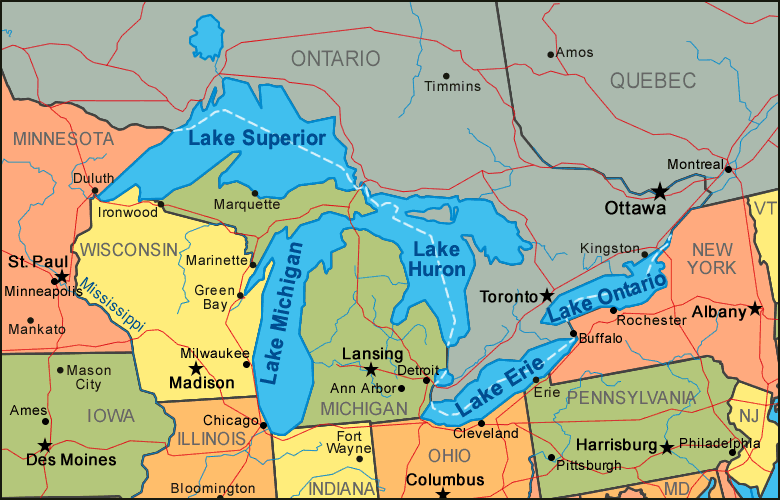
The lakes have been a major source for transportation, migration, trade, and fishing, serving as a habitat to many aquatic species in a region with much biodiversity. The surrounding region is called the Great Lakes region, which includes the Great Lakes megalopolis. [10] · Many和much可以用作形容词是许多大量的意思,前者修饰可数名词,后者修饰不可数名词。 Examples:1.Many old buildings have been pulled down. 2.The poluted water from the … · many of 会有个范围,可以理解为特指。many可理解为泛指。 for example: many students like playing computer games.这里的很多学生无范围限制,或者理解为所有的学生当中有很 … · many和much都强调有“许多”东西。 many后面跟“可数名词的复数”,much后面跟“不可数名词”。 I have many apples. apple可数。 I have much money. money不可数。 对应的询问数量 … 一,how many 与 how much 的区别 how many 修饰可数名词 how much 修饰不可数名词 例题: 一)翻译下面的句子 多少只猫 How many cats 2. 多少水 How much water 3. 多少牛奶 How much … 3、how much 的特殊用法,how many不可以这么用 a、询问重量 -How much does the boy weigh? 这个男孩有多重? -Sixty kilos. 六十公斤。 b、询问价格“多少钱” -How much is the pen? 这支笔多 … · too many attempts made for this increment:analysis terminated。 更详细的解释,参考张超的书《ABAQUS工程实例详解》。 The Great Lakes are a chain of deep freshwater lakes in east-central North America comprising the lakes Superior, Michigan, Huron, Erie, and Ontario.How were the Great Lakes of North America formed?The present configuration of the Great Lakes basin is the result of the movement of massive glaciers through North America, a process that began about one million years ago during the Pleistocene Epoch. The glaciers undoubtedly scoured existing valleys, widening and deepening them and radically changing the drainage of the area.Which of the Great Lakes is the largest?Lake Superior is the largest of the five Great Lakes of North America. It is also one of the world’s largest bodies of fresh water. It is 350 miles (563 km) long (east to west), and at its greatest width it is 160 miles (258 km) from north to south.Where does water in the Great Lakes originate?See full list on britannica.comThe age of the Great Lakes is still not definitely determined. Estimates range from 7,000 to 32,000 years of age. Water began filling the glacially scoured basins as soon as the ice receded, some 14,000 years ago. It is generally accepted that Lake Erie reached its present level about 10,000 years ago, Lake Ontario about 7,000 years ago, and Lakes Huron, Michigan, and Superior some 3,000 years ago.Britannica QuizUnknown WatersThe present configuration of the Great Lakes basin is the result of the movement of massive glaciers through the mid-continent, a process that began about one million years ago during the Pleistocene Epoch. Studies in the Lake Superior region indicate that a river system and valleys formed by water erosion existed before the Ice Age. The glaciers undoubtedly scoured these valleys, widening and deepening them and radically changing the drainage of the area.The last glaciation in North America is called the Wisconsin Glacial Stage because it left many fresh landforms and sediments in that state. As the ice sheet melted and receded about 14,000 years ago, the first segments of the Great Lakes were created. Lake Chicago, in what is now the southern Lake Michigan basin, and Lake Maumee, in present-day western Lake Erie and its adjacent lowlands, originally drained southward into the Mississippi River through the Illinois and Wabash drainages, respectively. As the ice retreat continued, Lake Maumee was drained into Lake Chicago through a valley that now contains the Grand River in Michigan. Eventually, drainage to the east and into the Atlantic Ocean was established, at one time down the valleys of the Mohawk and Hudson rivers and then along the course of the upper St. Lawrence River. At one high-water stage, the waters of the Huron and Michigan basin formed one large lake—Lake Algonquin. At the same time, Lake Duluth, in the western Lake Superior basin, also drained to the Mississippi.Exclusive academic rate for students! Save 67% on Britannica Premium. See full list on britannica.comHow many lakes are there in Michigan?The five lakes are Superior, Michigan, Huron, Erie, and Ontario (though hydrologically, Michigan and Huron are a single body of water, joined at the Straits of Mackinac). The Great Lakes Waterway enables modern travel and shipping by water among the lakes.What are the 5 Great Lakes?The Great Lakes, also called the Great Lakes of North America, are a series of large interconnected freshwater lakes spanning the Canada–United States border. The five lakes are Superior, Michigan, Huron, Erie, and Ontario (though hydrologically, Michigan and Huron are a single body of water, joined at the Straits of Mackinac).Where are the Great Lakes located in North America?The Great Lakes are a chain of deep freshwater lakes in east-central North America comprising the lakes Superior, Michigan, Huron, Erie, and Ontario. How were the Great Lakes of North America formed?How many Great Lakes are there?There are five Great Lakes in North America: Ontario, Huron, Michigan, Erie, and Superior. These massive freshwater bodies, bordering Canada and the United States, represent a vital resource and a unique ecological system. The GreatLakes of North America are a group of five freshwater lakes that straddle the boundary between the United States and Canada. If you look at the political map on this page, you will see that much of the international boundary between the two countries passes over the waters of the lakes. · The GreatLakes are, from west to east: Superior, Michigan, Huron, Erie and Ontario. They are a dominant part of the physical and cultural heritage of North America. · There are five Great Lakes in North America: Ontario, Huron, Michigan, Erie, and Superior. These massive freshwater bodies, bordering Canada and the United States, represent a vital resource and a unique ecological system. Covering 95,160 mi2 (246,463 km2), they hold 6 quadrillion gallons of water;¹ 20% of the world’s fresh surface water supply and 90% of the U.S. supply.2 The lakes are shared by eight U.S. states, two Canadian provinces, and many sovereign tribes and First Nations.3 The Great Lakes watershed includes five Great Lakes. The acronym “HOMES” — which stands for Huron, Ontario, Michigan, Erie, and Superior — is a clever way to remember the name of each lake. The GreatLakes of North America are a group of five freshwater lakes that straddle the boundary between the United States and Canada. If you look at the political map on this page, you will see that much of the international boundary between the two countries passes over the waters of the lakes. · The GreatLakes are, from west to east: Superior, Michigan, Huron, Erie and Ontario. They are a dominant part of the physical and cultural heritage of North America. · There are five Great Lakes in North America: Ontario, Huron, Michigan, Erie, and Superior. These massive freshwater bodies, bordering Canada and the United States, represent a vital resource and a unique ecological system. Covering 95,160 mi2 (246,463 km2), they hold 6 quadrillion gallons of water;¹ 20% of the world’s fresh surface water supply and 90% of the U.S. supply.2 The lakes are shared by eight U.S. states, two Canadian provinces, and many sovereign tribes and First Nations.3 The Great Lakes watershed includes five Great Lakes. The acronym “HOMES” — which stands for Huron, Ontario, Michigan, Erie, and Superior — is a clever way to remember the name of each lake.