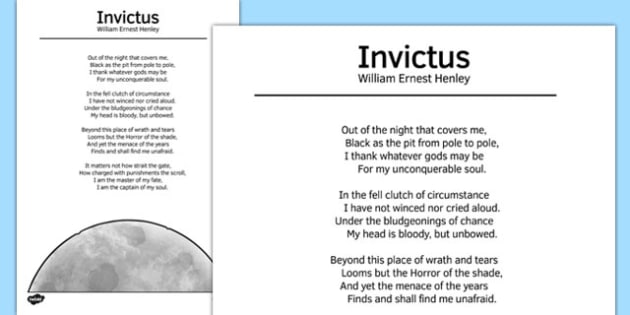
" Invictus " is a short poem by English poet William Ernest Henley. Henley wrote it in 1875, and in 1888 he published it in his first volume of poems, Book of Verses, in the section titled "Life and Death (Echoes)". For my unconquerable soul. I have not winced nor cried aloud. My head is bloody, but unbowed. Finds and shall find me unafraid. I am the captain of my soul. Copyright Credit: WilliamErnestHenley, "Invictus" from Poems (London: Macmillan and Co., 1920): 83-84. Public domain. Read the full text of Invictus, a famous poem by William Ernest Henley, a Victorian poet and critic. The poem expresses the speaker's unconquerable soul and mastery of fate and soul. "Invictus" is the Latin word for "unconquered." WilliamErnestHenley, born , was an influential British poet, perhaps best known for his poem “Invictus” (1875). Read the full text and learn about the context and poet of this famous poem about unconquerable soul. Invictus was written by Henley, a Victorian poet who suffered from tubercular arthritis and lost a leg. ‘Invictus’ is W.E. Henley’s most famous and inspirational poem, that resonates with people worldwide. He wrote the poem in 1875 and dedicated it to Scottish flour merchant named Robert Thomas Hamilton Bruce. Unlock all 225 words of this analysis of Allusion in “Invictus,” and get the poetic device analyses for every poem we cover.