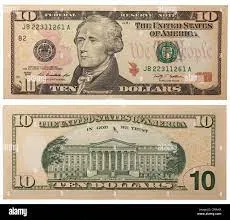
The obverse of the bill features the portrait of Alexander Hamilton, who served as the first U.S. secretary of the treasury, two renditions of the torch of the Statue of Liberty (Liberty Enlightening the World), and the words "We the People" from the original engrossed preamble of the United States Constitution. · Who is on the $10 Bill? The person featured on the U.S. $10 bill is Alexander Hamilton, the nation’s first Secretary of the Treasury. Since the currency was redesigned and given a standard size in 1928, Hamilton has been on the $10. His portrait was engraved from the 1805 John Trumbull painting that hangs in New York’s City Hall (you can see it behind the mayor’s podium when he is on television). The portrait of Hamilton currently used for Federal Reserve notes was introduced in the 1928 series $10 note. This portrait is based on a John Trumbull painting displayed in New York City Hall. · The 1861 $10 bill featured a portrait of Salmon P. Chase, President Lincoln‘s Treasury Secretary, who played a crucial role in financing the Union war effort. While many ask what president is on the $10 bill, it's actually Alexander Hamilton, who was not a U.S. president. The 1950 Series $10 Federal Reserve Note emerged in the post-World War II economic boom, a period of significant growth and societal shifts in the United States. Who Is on the 10 Dollar Bill? The current ten dollar bill features Alexander Hamilton. His portrait has been on the obverse side of the ten dollar bill since 1929. Alexander Hamilton was one of the founding fathers of the United States. He was a politician, lawyer, banker, and economist.